
Bon Appétit · 02
A Fish Worth Waiting For
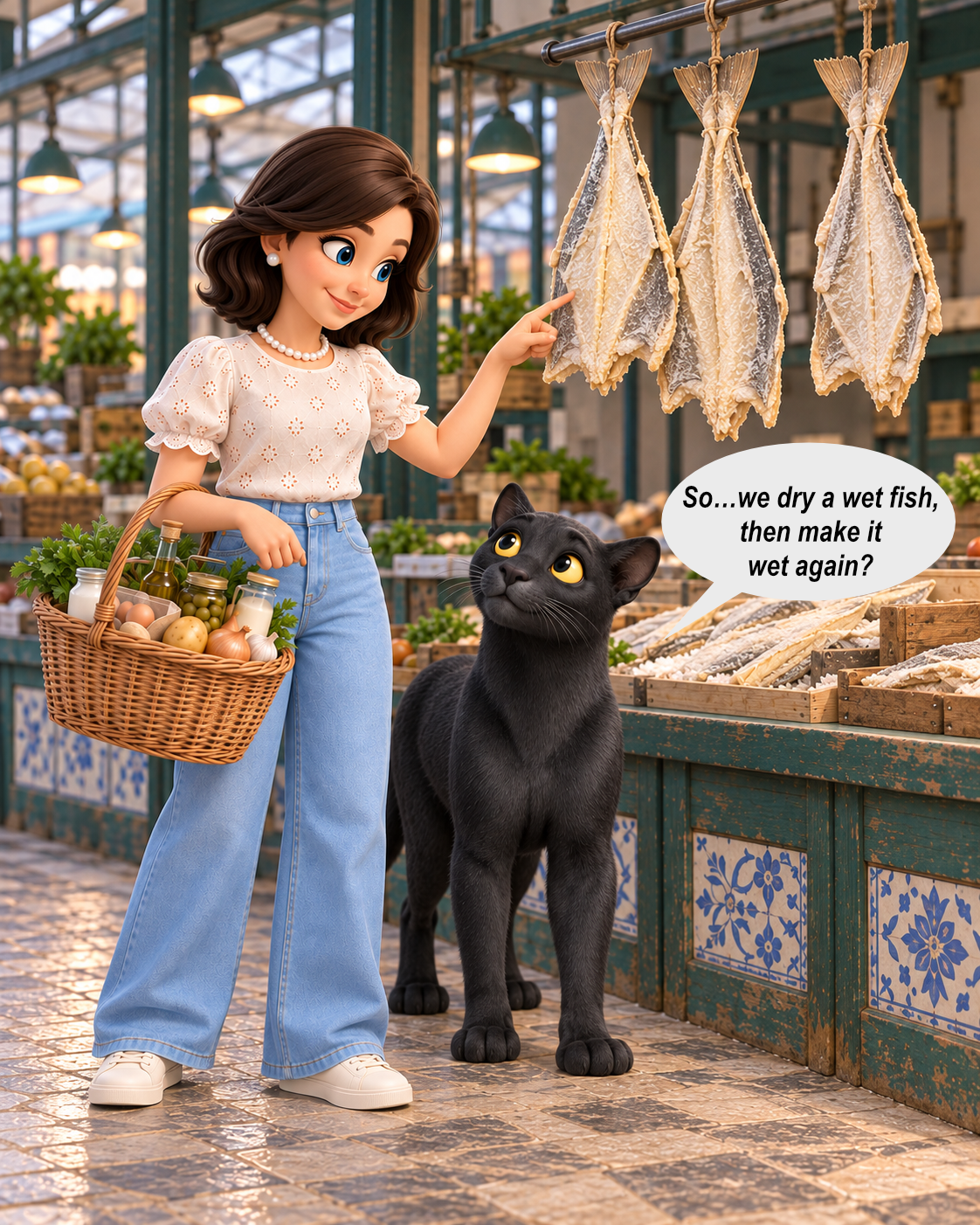
The Curious Bite
A Fish Worth Waiting For
Some culinary traditions sound a little strange from a logistical point of view.
Our furry companion certainly thought so when he first encountered a plank-hard, dried fish. And he asked exactly the right question: why go to all the trouble of drying a wet fish, only to put it back into water for days before dinner?
Behind this apparent mystery lies a story stretching back more than a thousand years, connecting the cold North with warmer southern kitchens. A story of resourcefulness, sea voyages, trade and, eventually, some very good food.
Same fish, different treatment
Stockfish and the salted, dried cod used in Portuguese bacalhau dishes often begin with the same fish: Atlantic cod. What happens next makes the difference.
Stockfish, called tørrfisk in Norway and stoccafisso in Italy, is dried without added salt. The cleaned fish is hung on wooden racks, where cold coastal air and wind gradually remove its moisture.
Salted bacalhau is salted and dried. In Norway, this type of product is known as klippfisk, or clipfish, traditionally dried on coastal rocks. Salting draws water from the flesh and contributes to its preservation and distinctive character. Strictly speaking, bacalhau simply means “cod” in Portuguese, although in traditional cooking it usually refers to the salted, dried version.
Both need water before they reach the cooking pot. Stockfish is soaked to soften its hard flesh; salted bacalhau is soaked to remove excess salt as well as restore moisture. The time required depends on the product and the thickness of the pieces. That bowl of water is doing considerably more work than Truffle suspects.
Nature’s drying room
The Lofoten islands offer particularly favourable conditions for making stockfish. During the traditional drying season, roughly from February to May, the weather is cold enough to slow spoilage while the air and wind gradually dry the fish. Drying commonly takes two to four months, depending on conditions. As moisture disappears, the organisms responsible for spoilage no longer have enough available water to thrive. No added salt required.
It is also the season when migrating skrei, a population of Atlantic cod, arrive from the Barents Sea to spawn along the Norwegian coast. A useful meeting of fish, weather and human ingenuity.
From northern voyages to southern tables
Stockfish was already used in the Viking age, providing preserved food for long sea journeys. We cannot name its first inventor or give an exact date of discovery, but its history reaches well beyond the refrigerator.
One memorable encounter took place in 1432, when Venetian merchant Pietro Querini was shipwrecked near Røst. Rescued by local people, he observed their stockfish traditions and later brought dried fish home to Venice. Centuries later, stockfish remains part of Italian cooking. One famous example is bacalà alla vicentina, which uses unsalted stockfish despite its locally confusing name.
Portugal developed its own enduring relationship with salted cod, with Portuguese fishing in Newfoundland waters documented by the early sixteenth century. Bacalhau became deeply rooted in the country’s food culture. Meanwhile, Norwegian stockfish also found a lasting place in Nigerian kitchens. These traditions have travelled far, and they are still very much alive.
And who was Gomes de Sá?
Our chosen dish, Bacalhau à Gomes de Sá, takes us to Porto. It is attributed to José Luís Gomes de Sá Júnior, a cod merchant who lived from 1851 to 1926. According to local tradition, he passed his recipe to a cook at the Lisbonense restaurant. His name lives on in a dish combining bacalhau with potatoes, onions, olive oil, eggs and olives.
What began as a practical way to preserve fish became a culinary tradition worth keeping. Drying, salting and maturation create flavours and textures that fresh cod cannot simply reproduce. Modern refrigeration may offer a shorter route to dinner, but it cannot recreate that history in a mouthful.
Fancy a taste?
Bacalhau à Gomes de Sá
Salt cod with potatoes, soft onions, garlic, eggs and black olives. My version started with a recipe in my mother’s old cookbook and has gradually acquired a few personal touches.
Serves 2 generously
Read the recipe
Ingredients
- 400 g dried, salted cod (bacalhau), before soaking and removing skin and bones
- Cold water for soaking
- 300 g potatoes, peeled weight
- 3 large onions, thinly sliced into rings
- 3 garlic cloves, crushed
- Equal quantities of milk and water, enough to cover the fish
- A generous amount of olive oil for cooking, plus good-quality olive oil to finish
- 3 eggs
- 10 black olives
- A few sprigs of flat-leaf parsley, finely chopped
- Freshly ground black pepper
Before you start: soak the bacalhau
Follow the supplier’s instructions for desalting. If none are provided, allow approximately 24–48 hours, with longer soaking for particularly thick pieces if needed.
Keep the fish submerged in plenty of cold water in the refrigerator and change the water regularly.
1. Prepare the potatoes and eggs
Steam or boil the potatoes in their skins until tender but still firm enough to hold their shape. Allow them to cool slightly, then peel and cut into cubes.
Hard-boil the eggs, cool and peel them. Set aside for the finishing touches.
2. Cook the fish
Drain the soaked bacalhau and place it in a saucepan. Cover with a mixture of half milk and half water.
Bring just to the boil, then reduce the heat and simmer gently until the fish is cooked and separates easily into flakes.
Lift it out with a slotted spoon and let it cool enough to handle. Remove the skin and bones, then separate the flesh into substantial flakes.
Strain and reserve the cooking liquid.
3. Let the fish rest
Place the fish flakes in a small, deep bowl and cover with the strained cooking liquid. Let them rest for at least 1 hour.
Plan this step shortly before assembling the dish. If preparing further ahead, cool promptly and refrigerate.
4. Soften the onions and garlic
Preheat the oven to 175°C, conventional heat.
Heat a generous amount of olive oil in a pan. Add the onions and garlic and cook gently over low heat until the onions are very soft.
They do not need to turn golden yet; the exposed onions may take on a little colour in the oven. Keep the heat low so the garlic does not burn and become bitter.
Cover the pan with a lid, or loosely with aluminium foil, to help the onions soften without drying out. Remove the cover once they begin to soften and continue cooking until tender.
5. Assemble the dish
Gently fold the potato cubes into the softened onions. Add the fish flakes and enough of their cooking liquid to keep the mixture moist, without making it soupy. Reserve the remaining liquid.
Season generously with freshly ground black pepper. Additional salt is usually unnecessary, as the bacalhau may still provide enough. Taste before adding any.
Transfer to a small ovenproof dish, taking care to keep the potatoes and fish flakes intact.
6. Bake
Bake for approximately 20 minutes, until the dish is hot throughout and lightly golden on top.
Keep an eye on the moisture: if the dish starts to dry out, add a little more reserved cooking liquid. The milk gives everything a softer, creamier finish.
7. Finish and serve
Cut the eggs into quarters and arrange them over the dish. Add the black olives and chopped parsley.
Finish with a generous drizzle of good-quality olive oil and serve immediately.
Mimma’s notes
If you enjoy Portuguese cooking, I can only recommend giving this dish a try. It takes a little planning, but the result is well worth the wait.
Choosing your fish
For this recipe, I start with 400 g of dried, salted bacalhau for a generous meal for two. The fish absorbs water during soaking, and the skin and bones still need to be removed afterwards, so the final yield depends on the cut.
As with fresh cod, bacalhau comes in different cuts and qualities. Good, thick pieces may cost a little more, but in my experience they are worth it.
Be generous with the olive oil
This is Mediterranean cooking, and I like to be generous with the olive oil. It helps the onions become beautifully soft, while a final drizzle of good-quality oil brings the dish together.
Cook once, enjoy twice
When I worked full-time, I often made a double batch so dinner was already taken care of for the following working day. Oven dishes and slow-cooked meals were particularly useful for that. A little extra cooking today, one less thing to think about tomorrow.
If you do the same, cool the extra portion promptly and refrigerate it. When reheating, add a little reserved cooking liquid if needed, cover to keep the fish moist and heat thoroughly. You can keep the finishing drizzle of olive oil and fresh parsley for serving.
The Quick KAT… or perhaps not
I may have to disappoint anyone in a hurry: there is no truly quick KAT for this recipe. The fish needs its soaking time, and patience is part of the preparation.
There is, however, a way to get ahead. I once prepared a larger batch of bacalhau, soaked and cooked it, then removed the skin and bones. I vacuum-packed a portion with some of its cooking liquid and froze it.
The cooking liquid matters: it helps keep the fish moist. When I used that portion later, I found it just as tasty. I have only tried this once, but it worked very well for me.
If you try it, cool the fish and liquid promptly, pack them cold and freeze straight away. Thaw in the refrigerator before using.
Truffle’s verdict
“Apparently, the main ingredient is patience. We didn’t buy any.”
Did this story make you smile?